
You wake up at 3 AM with a 102°F fever and body aches. Do you drive to the emergency room or wait until morning for urgent care?
The answer determines whether you spend $150 or $3,000; and whether you’re home in an hour or still waiting in a crowded hallway at sunrise.

📋 TL;DR: Key Takeaways
- 🚑 ER is for true emergencies: Chest pain, trouble breathing, stroke signs, seizures, severe trauma/burns, uncontrolled bleeding, or symptoms worsening rapidly overnight = go to the ER immediately.
- 🏥 Urgent care is for “sick-now” but stable: Flu, sore throat/ear infection, UTIs, rashes/mild allergic reactions, minor cuts needing stitches, sprains/minor fractures, and GI illness without severe dehydration are often treated faster at urgent care.
- 💸 Cost difference can be massive: Urgent care commonly runs $100–$200 for the visit, while ER bills for non-emergencies often land in the thousands (even for similar symptoms).
- ⏱️ Time isn’t just “wait time”: ERs are triage-based (door-to-provider vs total time). For stable issues, waiting until urgent care opens often means you’re treated and home sooner than arriving at the ER at 3 AM.
- 🧼 Environment matters: ER waiting rooms can mean more exposure to critically ill patients during flu season; urgent care is often calmer, more private, and more comfortable.
- 🔁 Escalation can be smoother: If urgent care finds you need hospital resources, strong documentation and a direct handoff can streamline the next step.
For Orlando residents, understanding when to use the ER versus urgent care saves money, time, and unnecessary exposure to critically ill patients. This guide breaks down the actual costs and wait times data.
ER vs Urgent Care: Where Should You Go?
Go to the ER Immediately
- Chest pain
- Trouble breathing
- Stroke signs (face droop/arm weakness/speech trouble)
- Seizures/loss of consciousness
- Severe burns/trauma
- Uncontrolled bleeding
- Suspected heart attack
Choose Urgent Care (Stable Conditions)
- Flu symptoms
- Minor cuts needing stitches
- Sprains/minor fractures
- Ear infection/sore throat
- UTI
- Rashes/mild allergic reactions
- Upper respiratory infection
- Vomiting/diarrhea (no severe dehydration)
The Decision Tree: Where Should You Go?
Go to the Emergency Room Immediately If You Experience:
- Chest pain or pressure lasting more than a few minutes
- Difficulty breathing or shortness of breath at rest
- Sudden severe headache with confusion or vision changes
- Loss of consciousness or seizures
- Severe burns or trauma
- Uncontrolled bleeding
- Signs of stroke (facial drooping, arm weakness, speech difficulty)
- Suspected heart attack symptoms
Why: These conditions require immediate access to advanced life-support equipment, trauma surgery capabilities, and specialists on call 24/7.
Choose Urgent Care for:
- Flu symptoms (fever, body aches, cough)
- Minor cuts requiring stitches (non-arterial bleeding)
- Sprains and minor fractures
- Ear infections and sore throats
- Urinary tract infections
- Skin rashes and mild allergic reactions
- Upper respiratory infections
- Vomiting and diarrhea without severe dehydration
Why: These conditions need prompt medical attention but don’t require hospital-level resources.
The Cost Reality: National Averages
The financial difference between ER and urgent care visits is substantial, even for identical conditions.
Typical Costs: ER vs Urgent Care
(Non-Emergencies based on national averages)
“Urgent care is often 5–10x less.”
Emergency Room Costs
Base visit: $2,715 average before any treatment.
Florida Context: In Florida, average ER bills often exceed $3,000 depending on the hospital and specific services rendered.
Typical ranges seen in consumer billing reports:
- Flu treatment: $1,500 – $3,000
- Earache: ~$400
- Sore throat: ~$525
- Urinary tract infection: ~$665
Note: These costs can vary widely by hospital and specific tests ordered.
These figures typically include triage fees ($200-$1,000), facility fees ($1,100-$1,200), professional fees (variable), and supplies.
Urgent Care Costs
Base visit: $100 – $200
Common condition costs at urgent care:
- Flu treatment: ~$127 – $150
- Earache: ~$110
- Sore throat: ~$94
- Urinary tract infection: ~$112
The Math: Urgent care costs typically 5-10x less than ER visits for non-emergency conditions.
Billions are spent annually on avoidable ER visits that could have been treated faster and more affordably at urgent care clinics.
The Time Reality: Orlando-Specific Data
Emergency Room Wait Times in Florida
It is critical to understand the difference between “Door-to-Doctor” time and “Total Time.”
- Door-to-Provider: This varies wildly by hospital volume, often 30–90+ minutes during peak periods.
- Total Visit Time (Arrival to Discharge): The Florida median is approximately 155 minutes (over 2.5 hours). However, in busy Orange County hospitals, total visits often exceed 4-6 hours when you include diagnostic testing, treatment, and discharge paperwork.
Important Note: ERs use triage systems that prioritize life-threatening conditions. If you arrive with flu symptoms while someone arrives with chest pain, you’ll wait longer—regardless of who arrived first.
Urgent Care Wait Times
- APMUC: Our typical walk-in wait is about 15 minutes.
- National Average: 30-60 minutes for walk-in patients.
Downtown Orlando and Dr. Phillips residents can typically schedule same-day appointments or walk in without multi-hour waits.
The Environment:
Sterile Chaos vs. Living Room Medicine
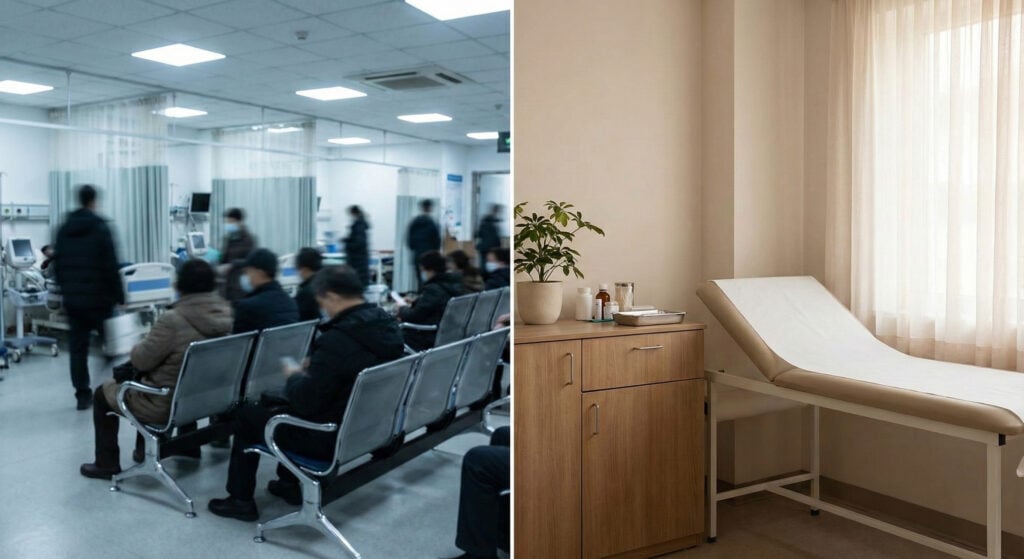
The Typical ER Experience
- Fluorescent lighting and institutional walls.
- Shared waiting rooms with critically ill patients.
- Background noise: monitors beeping, intercoms, trauma codes.
- Privacy limited to curtain dividers.
- Overcrowding during peak hours (evenings and weekends).
The APMUC Experience
- Private examination rooms with warm lighting.
- No exposure to trauma cases or critical emergencies.
- Concierge-level attention without the hospital environment.
- Direct access to Dr. Shemiranei: Multilingual (English, Spanish, Portuguese, French, Farsi).
- Comfortable waiting area designed for patient comfort, not institutional efficiency.
This matters for patients with compromised immune systems, young children, or elderly family members. Spending three hours in an ER waiting room during flu season exposes you to infectious diseases you didn’t arrive with.
Insurance Considerations
ER Visits
Most insurance plans require higher copays for emergency room visits—typically $250-$500 for in-network ERs.
The “Prudent Layperson” Standard: If your symptoms reasonably seemed emergent (the “prudent layperson” standard), coverage should apply. However, some plans still dispute claims if the final diagnosis is determined to be non-emergent, which can make costs unpredictable. Additionally, ER visits often count toward your annual deductible, meaning you pay the full cost until you meet that threshold.
Urgent Care Visits
Urgent care visits typically carry lower copays—often $50-$100 for in-network centers. Most insurers classify urgent care as a “specialist” or “urgent care” tier, distinct from the emergency tier.
APMUC accepts most major insurance plans and offers transparent self-pay pricing for uninsured patients.
Insurance Reality
ER copays are often higher
Typically $250–$500+. Often counts toward your deductible.
Urgent care copays are often lower
Usually $50–$100 for in-network centers.
Coverage can be unpredictable
Claims may be disputed if diagnosis is non-emergent ("prudent layperson" concept).
When Urgent Care Can’t Help:
The Seamless Handoff
Some conditions start as urgent care cases but require hospital resources (e.g., suspected fractures requiring surgery, deep lacerations, or chest pain).
When Urgent Care Needs to Escalate
At APMUC, Dr. Shemiranei provides direct communication with local hospitals when escalation is necessary. You’ll receive:
- Complete documentation of your examination and initial treatment.
- Direct physician-to-physician handoff (bypassing some ER triage steps).
- Diagnostic work already completed (labs, ECG, or imaging if available onsite).
This streamlines your ER admission and ensures continuity of care.
The Downtown Orlando and Dr. Phillips Advantage
Location matters for urgent medical needs. APMUC’s central location near Lake Eola serves Downtown Orlando, Dr. Phillips, College Park, Thornton Park, and surrounding neighborhoods.
- Accessibility: Easy parking, no multi-level hospital garage navigation, ground-floor entrance.
- Hours: Extended hours beyond typical 9-5 primary care (verify current hours at APMUC.com).
- Multilingual Care: Dr. Shemiranei’s fluency in five languages eliminates communication barriers that slow diagnosis and treatment in hospital settings.
- Services: APMUC offers rapid flu/strep testing, on-site X-rays, and IV fluids for mild-to-moderate dehydration.
Real-World Scenario: The Flu Decision
Option 1: Emergency Room
- Scenario: 11 PM arrival with 102°F fever, body aches, cough.
- Experience: 2.5-3 hour wait (lower priority triage level).
- Outcome: Rapid flu test, symptomatic treatment, discharge.
- Total Time: 4-5 hours.
- Cost: $1,500 – $3,000+ (before insurance).
- Result: Home at 4 AM, exhausted.
Option 2: Urgent Care (Walk-in Clinic Dr. Phillips)
- Scenario: 9 AM walk-in with same symptoms.
- Experience: ~15 minute wait.
- Outcome: Same rapid flu test, same symptomatic treatment, prescription sent electronically to pharmacy.
- Total Time: ~45 minutes.
- Cost: ~$127 – $150 (before insurance).
- Result: Home by 10 AM, resting comfortably.
For most uncomplicated flu cases, the medical outcome is similar. The time, cost, and patient experience are not.
The Bottom Line
Emergency rooms serve a critical function for life-threatening conditions requiring immediate intervention. For these situations, cost and wait time are irrelevant—you need the ER.
However, for the vast majority of acute but non-emergency conditions, urgent care provides faster, more affordable, and more comfortable care. Given the typical 2-3 hour total ER visit times in Orlando, urgent care is the practical choice for flu, infections, minor injuries, and acute illnesses.
At Advance Preventive Medicine Urgent Care, we combine urgent care speed with concierge-level attention in a comfortable, non-institutional environment. Walk-in patients are welcome.
Location: 1400 E Robinson Street, Downtown Orlando (serving Dr. Phillips, College Park, and surrounding areas)
When to call ahead: If you’re unsure whether your condition requires ER-level care, call APMUC first. Dr. Shemiranei can assess your symptoms and provide guidance, potentially saving you hours and thousands of dollars.
Medical Disclaimer: This article provides general guidance and does not constitute medical advice. When in doubt about the severity of your condition, call 911 or go to the nearest emergency room. Do not delay emergency care to visit urgent care if you’re experiencing potentially life-threatening symptoms. Time-sensitive conditions like heart attacks and strokes require immediate ER intervention.